



Break your bad habits now, because if you choose later, these things will happen.
- Stagnation
- Missed Opportunities
- Declining Health
- Relationship Strain
- Regret
- Low Self-Esteem
- Financial Strain
- Emotional Turmoil
- Stuck in a Rut
- Limited Potential
- Isolation
- Increased Stress
- Lack of Fulfillment
- Worsening of Mental Health
- Loss of Motivation
- Damage to Reputation
- Procrastination
- Unhappiness
- Unhealthy coping routines
- Guilt and shame
- Impaired Decision-Making
- Hindered Personal Growth
- Negative Impact on Others
- Loss of Trust
- Untouched unpursued dreams
I know it’s hard, but you have to do it anyway. If you examine the repercussions of not making changes when they need to be made, you really don’t have a choice.
So let’s get into it.
Here’s my damn near expert advice on how to break habits for good, period. I got this advice from years of listening to personal development podcasts, reading books from experts, going over several scientific articles, and doing this whole process myself.
It will help. Pay attention.
Break your bad habits (Step 1) What’s the habit?
Normally the simplest first step, but not always, is to figure out what the habit is that you want to change. Sometimes you might know a change needs to be made in your life, but not where or why.
Sometimes we just feel out of whack.
Maybe you wake up each morning lethargic or everytime you ask for a raise your boss says “no”. So what habits and routines are keeping you back then?
There is some introspection required, but it could be as simple as “I want to stop snacking late at night. It’s affecting my sleep.”
If you’re having an issue isolating which habit or routine behavior needs to be changed, start by stating what you don’t like about your life, or situation. Then move on to figuring out why that something is in your life at all. What’s causing it?
What’s the cue?
The cue in the “cue – routine – reward habit loop” is the external stimulus that causes the routine to execute automatically. Remember, routines are automatic behaviors in sequence.
They start, we execute, and they end with some form of desirable result. The problem is, that result might be a sugar rush, or comfort of not having to exert ourselves.
So when you get to the point where the rewards you get from your routines no longer suit who you are, who you want to be, it’s time to isolate that sequence that’s deeply programmed into you.
What triggers the routine response? Is it seeing your favorite sandwich shop? Is it hearing the theme song to your favorite TV show that prompts you to get a whole bag of peanuts and relax for the night?
The “cue” for a slot machine is the coin dropping into the machine. Then it executes a routine.
Cue’s can be external and internal. It could be smelling coffee, hearing someone bickering about work, your dogs barking…
Cue’s can also be things like the time of day, a certain feeling you have, a person you see everyday, or seeing a particular object like a blanket, laptop or an ice cold soda in the fridge.
For example, feeling stressed (internal cue) might trigger the habit of biting your nails (behavior).
So, sit here and figure out what triggers the automatic routine you execute that houses the bad habits you want to be rid of.
What’s the craving?
By now, the whole habit and routine program should be getting clearer to you. Next, we identify the craving.
The craving is the reason why it’s so hard for you to break your bad habits – it’s closely tied to a reward you receive, having been triggered by the cue, and now you feel inexplicably drawn to executing the routine.
- The cue triggers the trap.
- The mouse knows there’s cheese at the end of the maze. The mouse loves cheese.
- So the mouse goes through the maze in order to find the cheese and get a delicious reward.
Cravings are intense desires or urges for a specific reward associated with a habit.
For example: seeing a fast-food advertisement on the side of the road (cue) triggers the craving for that fast food (reward), leading to the habit of grabbing a burger on the way home from work.
Because this is a program running over and over again in your brain and body, you think you’re the one making decisions. When the reality is your brain and biology are making those decisions for you.
They’re running programs. When the programs are no longer good for YOU, YOU must change them. This is the key you want to understand if you want to successfully break your bad habits.
This is essentially what habit and routine change are: taking control of the programs that run your automatic behaviors.
What’s your response? What’s the reward?
What do you get from going through with this programming habit? What do your brain and body get?
There are several types of rewards you could receive (biological, physical, mental, psychological, emotional and intellectual) and you want to get to the bottom of it.
Knowing the reward this habitual routine offers you is essential if you want to break your bad habits for one reason; you can replace the reward (get the same reward from something healthier).
Here’s a list of possible rewards you could get from your habits. You can see why they’re so addictive. When you’re used to getting these rewards, it’s damn hard to stop.
- Temporary relaxation
- Immediate gratification
- Sensory pleasure
- Pain relief
- Energy boost
- Dopamine release
- Adrenaline rush
- Stress hormone reduction
- Appetite suppression
- Temporary relief from withdrawal symptoms
- Distraction from your problems
- Mental escape / any type of escapism from reality
- Reduced boredom
- Comfort in general
- Fleeting happiness
- Reduced anxiety
- Emotional numbing
- Excitement
- Feeling in control
- To avoid discomfort
- Coping mechanism
- Self-confidence boost (liquid confidence)
- A sense completion or finality
- Mental relaxation
- A break from cognitive stress
Charles Duhigg in his famous book The Power of Habit, talks about the golden rule of habit change: keep the cue and the reward the same, but change the routine.
So, your job is to find a new routine that provides the same reward as the old routine. The new routine only has to provide the same reward, it doesn’t necessarily need to provide the same amount of the reward.
The rewiring process will have some withdrawal symptoms if the reward is less with the new routine, but you’ll get used to it.
If you want to break your bad habits, remember these facts about habits and your reward system.
- When a habit is rewarded your brain releases dopamine. This creates a sense of pleasure and satisfaction that you seek over and over again.
- An immediate reward will always be better at wiring in new habits that delayed rewards.
- According to habit change experts and my own personal experience, cravings drive you to complete the habit loop by pulling you towards the reward.
- In the book Atomic Habits it says that the reward has to meet your expectations. Find a reward that does the job and is better than the “bad habits” reward.
- A scientific study found that connecting rewards to meaningful goals enhances your motivation to do it.
What’s the reason the habit exists?
What do you need that this habit offers you? When a habit is so ingrained that it becomes an addiction you need to satisfy, its because it offers you something you long for.
Check those rewards in the previous section. Find one on that list that fits your situation. If you can’t find one on that list, do something digging in your own mind and figure it out. Be honest with yourself and tell yourself what you need that this routine brings into your life.
Once you’ve done that, ask yourself why you need it. No reason to be afraid of confronting this. Nobody outside of you even knows you’re doing it. Sit in a comfortable spot and get personal with your needs and wants.
In the short term, you want to find something healthier that provides this need for you. In the long term you want to rid yourself of the need in the first place or find the healthiest, most beneficial way to acquire it.
What are your goals?
The only reason you feel the need to break your bad habits is because you now have different goals in mind for your life. Sometimes we don’t see the error of our ways, but even the most stout believers of “just have fun in life” eventually realize the importance of having sustainable routines.
Hell, even Ron White stopped drinking. Remember when he said “I think there’s only so much alcohol you can drink in one lifetime, and I drank mine.”
He’s the last person ANYONE ever thought would quit drinking. It was a part of his act, his routine, his personality was being the guy who told jokes and had a drink in his hand.
Maturity turns the “just have fun in life” bone into the “maybe i should reign this in a little bit” bone.
So, what are your goals? Your bad habit facilitates one, your new desire facilitates another. Ask yourself, “I used to do things a certain way and it was fine for me then, but what do I want for myself now?‘
You’ll be much more motivated to break your bad habits when you understand WHY YOU WANT TO.
What are the new behaviors?
What new habit or routine did you replace the old habit/routine with?
There also might be secondary and tertiary habits related to this “bad habit” that need to be examined as well. Like if when you sit down in the evening to eat that entire bag of chips do you scroll through Instagram anything like that?
That type of activity spikes your dopamine and creates addiction as well. So there might be several habits that are a part of the old routine that need to be replaced with better habits, or none at all.
What’s your plan?
Hot and Cold empathy gap is a cognitive bias that causes us to judge how well we will perform in the future based on the state we’re in now. You decide how you’ll act when you’re hot (feeling good) when you’re cold (feeling bad) and vice versa.
For example: we always tell ourselves that we’ll do it later. You put off that thing until later in the evening and think you’ll be fine. You judge your ability to do the thing later on that day based on how you feel earlier in the day.
But when “later in the day” arrives you’ve already been awake for twelve hours, are tired from work, hungry, worn out from whatever stress the day causes, and you’re just ready to relax. So you put that thing off until tomorrow morning.
When you want to break your bad habits, don’t leave the responsibility of doing so for last minute right before the trigger pops. You’ll be weak at that point, and you’ll have to fight your brain (and its addiction to the dopamine spike it’s anticipating) with the power of your free will only.
You’re certain to fail if you do it that way. If you want to make sure this doesn’t happen to you my favorite tools for it are Makeover your mornings and Make over your evenings.
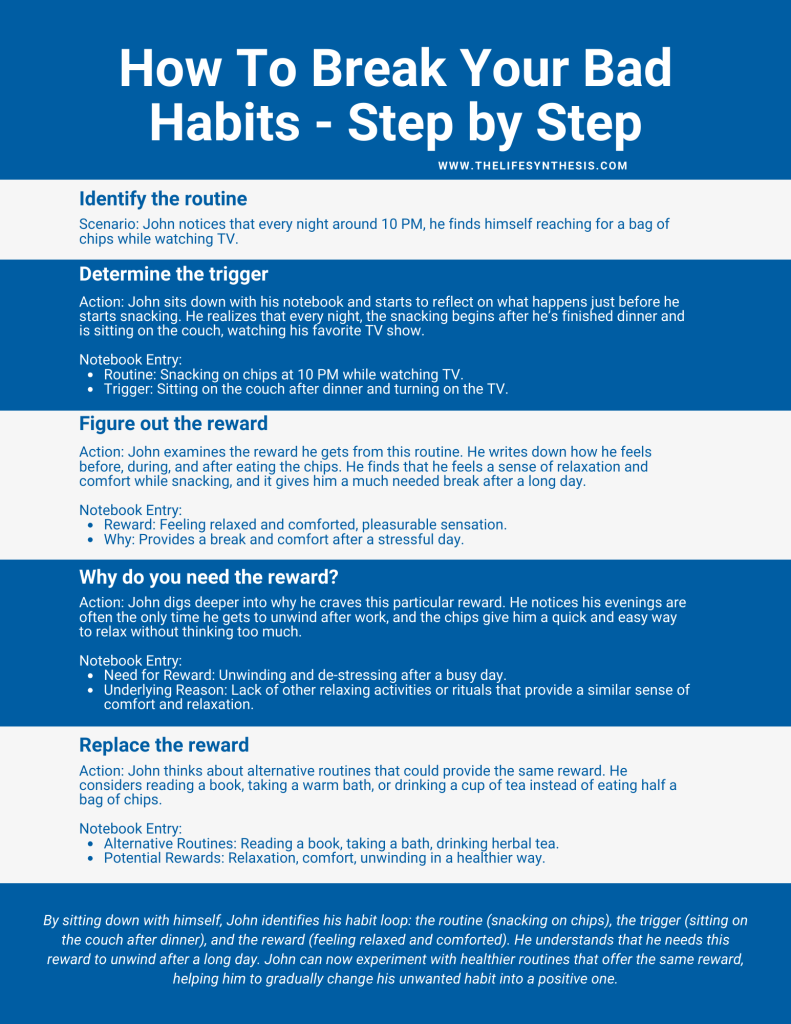
The solution is to prepare. (using the example of john in the image of a previous section) When you’re feeling good and motivated, get rid of the chips ahead of time, set the tea bags next to the pot, and fill the pot up with water so that all you have to do is turn the burner on.
You could even prepare the tea ahead of time and put it in a thermos, then stick it right by your seat in the living room. Throw the chips in the trash so you’re not tempted to break your promise to yourself.
Ideally you prepare for these things before the trigger pops and the routine program starts. Early in the morning when your states are managed properly and your willpower is at its highest is best.
Now build consistency. Even a small amount
You can trick yourself into being consistent. The key is small changes made with consistency. Those transform gradually into big changes and eventually you’ve been transformed.
James Clear, in his book Atomic Habits, says “consistent changes over time, lead to significant results.” Focus on small improvements but do them regularly and you’ll find that you build positive routines that compound and yield the outcomes you’re looking for.
It might seem flimsy but, frankly, it’s much more effective than sudden changes all at once. Trying to go cold turkey on something leaves us feeling overwhelmed and is, generally speaking, unsustainable.
The cold turkey approach to habit change is my preferred method. I’d rather suffer greatly through withdrawal symptoms and pain for a shorter amount of time than wait for results. However, its not an approach I’d recommend to others unless you already know you’re someone who can handle it.
Fact: small habits are easier to maintain than large, right now type changes.
The next thing I want you to remember is the power of making habits super easy to start. It’s simple to figure out how.
- Think about the habit in your mind
- Experience the “brain pain” – your brain says “But I don’t wanna!‘
- Make the habit change smaller and smaller until that brain pain goes away
- You’ll know its small enough when you think “Yeah I could manage that.”
- Then do that.
With smaller habits, your goal is to reduce friction between old routine and new routine. Friction will cause you to lose motivation. Progress is more important that staggeringly large results right this minute.
Remember, you are writing a new program for yourself. The size or amount affects how powerful the rewiring is, but consistency is also effective – it just takes a little longer. So if you’re someone who’s tried and failed over and over again, this is your ticket to success.
New habits are new identities. You won’t be the same person after. When you struggle to break your bad habits, it’s because you failed to transform your identity.
If you’re not a drinker, when someone offers you a drink, you reject it…with ease. There’s no work involved, because you behave in accordance with your identity 100% of the time. Drinking goes against your identity, so you reject it.
If you’re someone who goes to the gym, its easy for you to make that a part of your daily routine. We are always going to reinforce our own identity with our habits and routines.
Consistent changes help you remove and add things to your identity. Small habits over time add up. Soon, whatever your new habit is, you’ll be a person who “does that‘ and it will become easier each time you do it.
Modify the Environment
Don’t be a dummy and leave all your triggers in the house! You’re asking for trouble. Get rid of the snack foods, the porn, the alcohol, turn your phone off so you wont get your party monster friends call, or whatever you’re dealing with.
Set yourself up for success by making the new habit change as simple as possible – like putting your clothes out the evening before work the next morning. The less you have to exert yourself the easier it is to break your bad habits!
- Remove temptations and clutter. For example, place healthy snacks at eye level and hide/get rid of junk food.
- Set up reminders in visible places, like sticky notes on the bathroom mirror for morning routines. Create dedicated spaces for specific activities, such as a quiet, organized area for studying or exercising.
- Use tools and technology, like apps or alarms, to prompt and track your habits.
Design your environment to embrace your positive habits and you’ll make behavior change more automatic and sustainable.
Keystone habits
In Martin Meadows’ book How to build self discipline he talks about Keystone habits and how they structure your life and make it easy to break your bad habits.
Here are a list of keystone habits he recommends:
- Regular Exercise
- Healthy Eating
- Waking Up Early
- Saving Money
- Meditation
- Trying a New Thing Daily
- Expressing Gratitude
- Keeping a Tidy Environment
- Journaling
- Reading Daily
Relapses might happen
They happen. That doesn’t mean you’ve failed and it doesn’t mean you should stop. The reprogramming works regardless of how many times you’ve failed, so if one day you mess up go ahead and restart that moment or the next day.
- Acknowledge your Progress
- Be Kind to Yourself
- Recommit and focus
- Remember this is a process and each step counts
- Stay Persistent
Reflect on your plan
Take time to reflect on your journey so far. What has worked well? What needs adjustment? Refine your approach. Create a plan that addresses potential obstacles and includes strategies to overcome them.
Use implementation intentions is a little hack you can use to break your bad habits.
Never give up!
Whatever happens in your life – never lose faith, and never give up. Obstacles may come, but never let them cause you to quit.
“A transitional character is one who, in a single generation, changes the entire course of a lineage.
The changes might be for good or ill, but the most noteworthy examples are those individuals who grow up in an abusive, emotionally destructive environment and who somehow find a way to metabolize the poison and refuse to pass it on to their children.
They break the mold. They refute the observation that abused children become abusive parents, that the children of alcoholics become alcoholic adults, that “the sins of the fathers are visited upon the heads of the children to the third and fourth generation.”
Their contribution to humanity is to filter the destructiveness out of their own lineage so that the generations downstream will have a supportive foundation upon which to build productive lives.”
Highly Recommended tools


Sources, Authorities and Expertise for this article
- The Power of Habit by Charles Duhigg
- Atomic Habits by James Clear
- How to build self discipline by Martin Meadows
- https://www.semanticscholar.org/paper/Can%E2%80%99t-Control-Yourself-Monitor-Those-Bad-Habits-Quinn-Pascoe/3e8166555a8e0a3e4c4189f1fd88467443ba8844
- https://www.semanticscholar.org/paper/Psychology-of-Habit.-Wood-R%C3%BCnger/cfd7237c53905b7ce622fa967bf2c817fce4f979
- https://www.semanticscholar.org/paper/How-do-people-adhere-to-goals-when-willpower-is-low-Neal-Wood/c153cddf5a344a6772b83ae226fe243f40e9c50d
- https://www.semanticscholar.org/paper/Habitual-Behavior-Is-Goal-Driven-Kruglanski-Szumowska/41f2b46c45addd5d32ba157c71b2680c43f11f88